


Research and Application
This section outlines the theoretical and contextual research that informs the project. It includes key readings, case studies, and artistic references, demonstrating how research has been critically analysed and applied to the development of the work.

GENDER TROUBLE
Judith Butler
Judith Butler’s Gender Trouble is central to this project because it helps explain how behaviour becomes socially produced, repeated, and normalised. Butler argues that gender is not simply something people “are”, but something repeatedly performed through acts, gestures, language, and social expectations. Within the context of women’s safety, this theory helped me understand vigilance as a gendered performance: women are repeatedly taught to plan routes, avoid certain areas, stay alert, hold keys, share locations, and monitor their surroundings. Butler’s theory supports the project’s argument that responsibility for safety is embedded within everyday conduct and displaced onto women, instead of being addressed structurally.
FORTUNES OF FEMINISM
Nancy Fraser
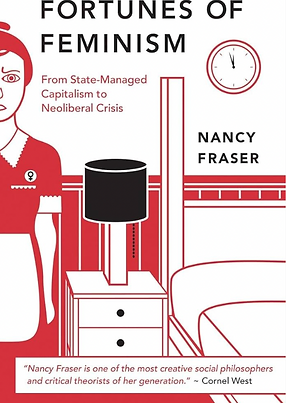
Nancy Fraser’s Fortunes of Feminism provides the structural foundation for my project. Fraser critiques how feminist ideas such as empowerment, autonomy, and awareness have been absorbed into neoliberal systems, where responsibility is shifted away from institutions and placed onto individuals. This is important because women’s safety is often addressed through advice, awareness campaigns, and self-management rather than through structural prevention. Fraser’s work helped me to move beyond analysing individual behaviours and instead question the broader systems that produce and sustain inequality.

TECHNOFEMINISM
Judy Wajcman
Judy Wajcman’s Technofeminism perspective challenges the assumption that technology and design are neutral, instead revealing how they are shaped by social relations, including gendered power structures. This was crucial for the evolution of my project because it helped me move away from my initial solution-based idea and question whether safety technologies actually challenge the problem or simply reproduce it. Her work highlights how safety systems, infrastructures, and technologies frequently assume a self-managing subject who must interpret information, monitor risk, and act accordingly. This reinforces a model of responsibility centred on individual behaviour rather than collective protection.
DESIGN JUSTICE
Sasha Costanza-Chock
Sasha Costanza-Chock’s Design Justice is central to the project because it challenges dominant design practices that present themselves as neutral, arguing instead that design is a site where power is distributed and inequality can be reproduced. This theory helped me analyse safety advice as a designed system. Posters, webpages, public guidance, transport warnings, and official advice are not just communication materials; they are design outputs that construct who is responsible for safety. Design Justice enabled me to critically examine design not only as a set of artefacts, but as a broader system of communication, governance, and control.


FIX THE SYSTEM, NOT THE WOMEN
Laura Bates
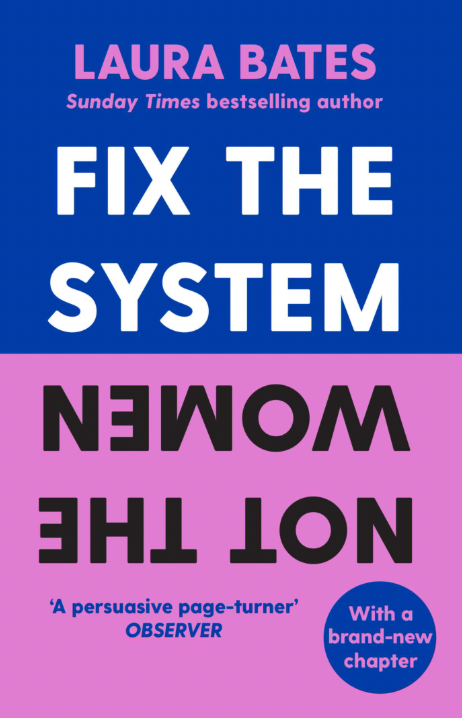
Laura Bates' Fix the System, Not the Women is one of the most relevant texts for this project because it clearly challenges the idea that women should be responsible for preventing harm. Bates exposes how everyday sexism operates across a spectrum, from subtle cultural norms to explicit violence, demonstrating that these are not isolated incidents but interconnected manifestations of systemic failure. This directly supports the project's argument, Bates exposes this logic as part of a broader pattern that places responsibility on the individual rather than addressing the structures that allow harm to happen.
INVISIBLE WOMEN
Caroline Criado Peres
Caroline Criado Perez’s Invisible Women highlights how systems are often designed around male norms, rendering women’s experiences invisible. This provides an important foundation for understanding how gendered design bias operates not only in physical environments, but also in policies, infrastructures, and institutional practices. This theory supports the idea that women’s safety is shaped by design decisions that fail to account for their lived experiences. Poor lighting, unsafe routes, inaccessible reporting systems, and unclear transport guidance are not just practical problems; they reveal whose experiences have been prioritised and whose have been ignored.


A CYBORG MANIFEST
Donna Haraway
Donna Haraway’s Cyborg Manifesto offers a critical perspective on the relationship between bodies, technology, and power. Her concept of the cyborg challenges fixed boundaries between human and machine, revealing how contemporary life is mediated through technological systems that are deeply embedded in political and social structures. This was important in the early development of my project because I initially considered a technology-based safety object. It allowed me to critically engage with the role of technology in women’s safety. However, her theories also contributed to the shift toward a more critical project focused on language, institutions and lived experiences, questioning not just what tools exist to keep women safe, but why those tools are necessary in the first place.
THREE WEEKS IN MAY
Suzanna Lacy
Suzanne Lacy's Three Weeks in May is important because it transforms sexual violence from a hidden, individualised issue into a public and collective record. In her work, Lacy mapped reported rapes across Los Angeles over twenty-one days, marking each case and making visible the scale of violence that is often buried within police archives, private experiences, and institutional statistics. I was inspired by how Lacy translated abstract data and institutional knowledge into something perceptible and impactful, demonstrating that visibility itself is a critical tool in addressing structural issues. This connects to my project, which similarly seeks to expose systems that are often normalised or overlooked, particularly those that shape how responsibility for safety is understood and communicated.


YOUR BODY IS BATTLE GROUND
Barbara Kruger
Barbara Kruger's Your Body is a Battleground is a key reference because of its use of bold typography, direct address, and the visual language of authority. Kruger appropriates the aesthetics of mass media and advertising to expose how women's bodies are politicised, controlled, and spoken about by institutions and cultural systems. Her work demonstrates that design is never neutral, but actively shapes meaning and perception. It inspired me both visually and conceptually, informing not only the use of bold, authoritative aesthetics, but also a critical approach to language as a tool that constructs power and responsibility within institutional communication.
TRUISMS
Jenny Holzer
Jenny Holzer's Truisms was one of the first works that made me understand how language itself could be a critical tool. Her short, authoritative statements mimic the tone of official messaging, revealing how easily such language can shape belief and behaviour. She made me realise that I did not need to explain the problem, I could make people feel it through the words themselves. This directly shaped my decision to appropriate institutional safety language in the final exhibition to expose how it places the responsibility of safety onto women's behaviour.


FACTORY OF THE SUN
Hito Steyerl
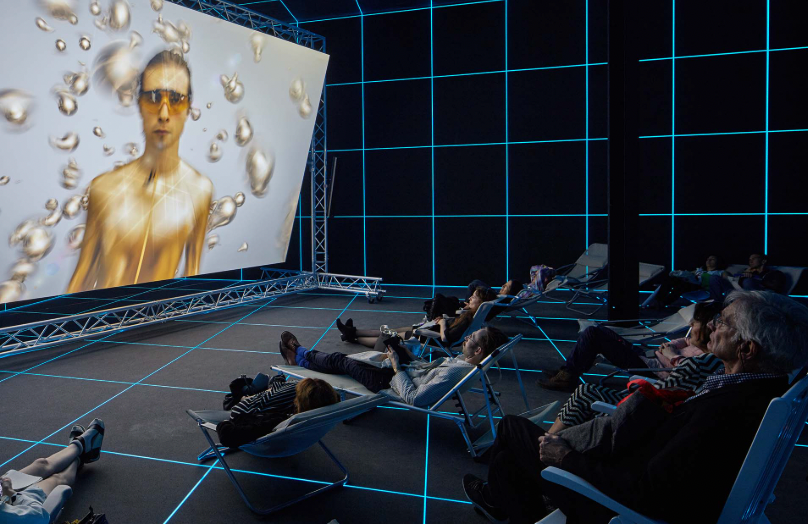
Hito Steyerl's Factory of the Sun influenced my thinking about immersion as a critical method. Rather than explaining a system, her work places the viewer inside it using space, light, and sound to make structures of power feel real rather than abstract. After analysing her work, I began thinking about how my own project could use immersion in a similar way, placing the audience inside the experience of fear and vigilance rather than simply illustrating it from the outside.
DO WOMEN HAVE TO BE NAKED TO GET INTO THE MET MUSEUM?
Guerrilla Girls

The Guerrilla Girls' Do Women Have to Be Naked to Get into the Met. Museum? showed me how data and satire could work together as a form of institutional critique. What drew me to their work was how they used an institution's own evidence against it, making structural inequality impossible to ignore through visual clarity and irony rather than academic argument. Their approach made me think about how the same strategy could be applied to women's safety, treating institutional language not as neutral guidance but as material to be examined and questioned.


THE MISSING VOICE
Janet Cardiff
Janet Cardiff's The Missing Voice was brought to my attention by my supervisor during a tutorial, and it became one of the most significant references for the project. Her audio walk captures the internal thoughts of a woman navigating a city alone, turning a private psychological state into something the audience can physically move through and feel. Her work made me think about how the internal experience of vigilance, the constant calculation that women describe, could become the subject of the work itself rather than just its context.
PRIMARY RESEARCH
Alongside these theoretical and artistic references, I conducted primary research to ground the project in lived experience. A Microsoft form questionnaire was distributed anonymously to between 15 and 20 women, combining multiple choice and open responses across 25 questions. Almost every participant reported adopting the same behaviours such as calling someone while walking, removing headphones, pretending to be on the phone, changing route, revealing consistent patterns of self-monitoring and risk management. These responses were essential, they became the direct inspiration and foundation for the monologues in the final exhibition, providing the emotional texture, the fragmented thought patterns, and the specific scenarios that the monologue scripts are built from.


