

Project Progression
This section presents the creative and conceptual development of the project over time. It includes early experiments, drafts, feedback from crits, and iterative design stages, highlighting how ideas were tested, refined, and transformed.

WEEK 2
The project started during the Project Management Skills workshop, where I was tasked to define a core research territory. Driven by a personal experience, I proposed an investigation into 'Women’s Safety Tools.' I used this week to map out my first thoughts on women’s safety. I looked at the link between fear and everyday objects.
WEEK 4
During week 4, I created a handmade zine to express the emotions behind my research. I used collage and bold text to contrast the feeling of being "trapped" with the desire for freedom. Phrases like "I want to be free, not brave" became key to my project. This was my first attempt at using visual communication to challenge the idea that women should always have to be on guard.


INITIAL IDEA PRESENTATION
In week 6 I presented my initial project idea, before the proposal. At this stage, the focus was on women's safety as a problem to be solved through design and innovation: a branding concept that merged fashion and technology to create smarter, more empowering safety tools for women. The presentation mapped key themes including institutional distrust, the narrative of fear, gendered design failures, and the gap between safety technologies and real lived experiences. It also included early research into relevant theorists which would later become the backbone of the project's theoretical framework.
CREATIVE OUTPUT
For the creative output, I developed a mood board poster that visually represented the project's early direction. The composition moved from the outside in, dark, tense imagery evoking fear and vigilance, gradually shifting toward softer, warmer tones at the centre. There, the silhouette of the bag symbolises technology, empathy, and collective empowerment.


PROPOSAL
While writing the initial proposal, I began researching artists, theorists engaging with similar themes to my own. This involved exploring how feminist theory had approached gender, power, and institutional failure, and starting to build a theoretical framework to support the project's direction. This early research was crucial in grounding the proposal and began to shape how I was thinking about the topic.
FEEDBACK ON THE INITIAL PROPOSAL
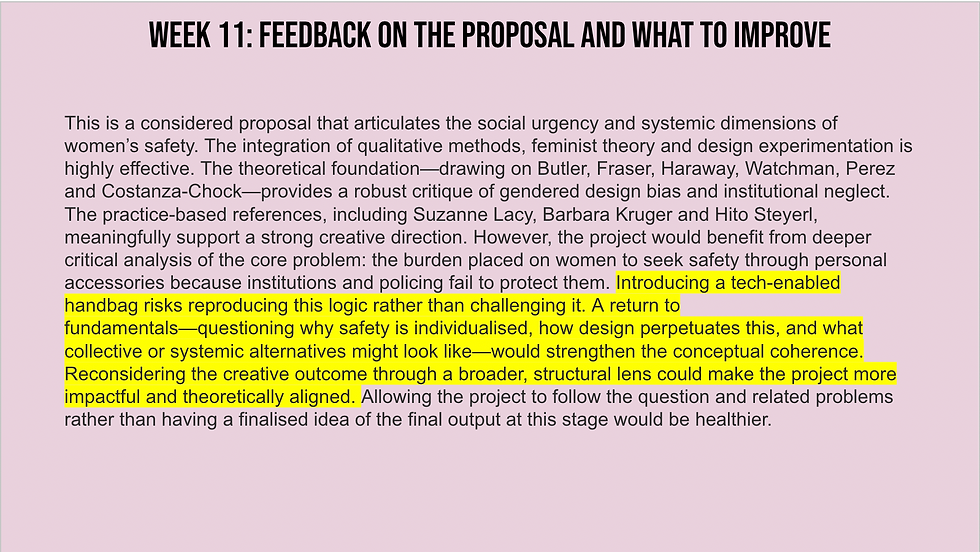
In week 10, I received feedback on my proposal that became the turning point of the entire project. While the theoretical framework and research approach were acknowledged as strong, the feedback highlighted a critical contradiction: introducing a tech-enabled handbag as a creative output risked reproducing the very logic the project aimed to challenge, that women are responsible for managing their own safety. This pushed me to step back from the solution-oriented direction and return to the fundamental question: why is safety individualised in the first place?


TATE MODERN VISIT
In week 11, I visited Tate Modern, which was an important moment for the project. The most directly relevant work I encountered was the Guerrilla Girls, whose data-driven posters exposed institutional inequality through sarcasm and statistics, reinforcing my thinking about how authority and language could be turned against itself. The visit deepened my understanding of how artists use visual systems, text, and space as tools for critical investigation, which fed directly into how my own project was developing.
JANUARY CRITS
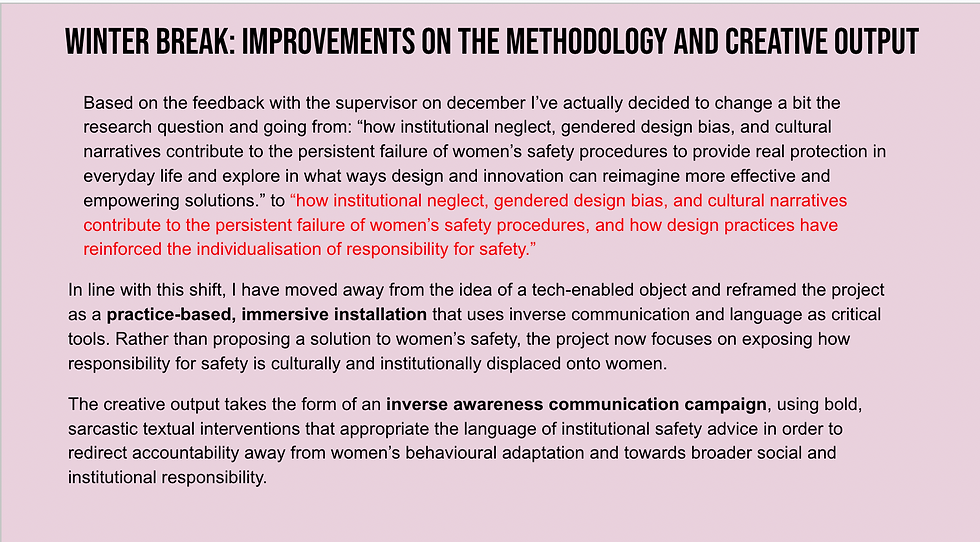
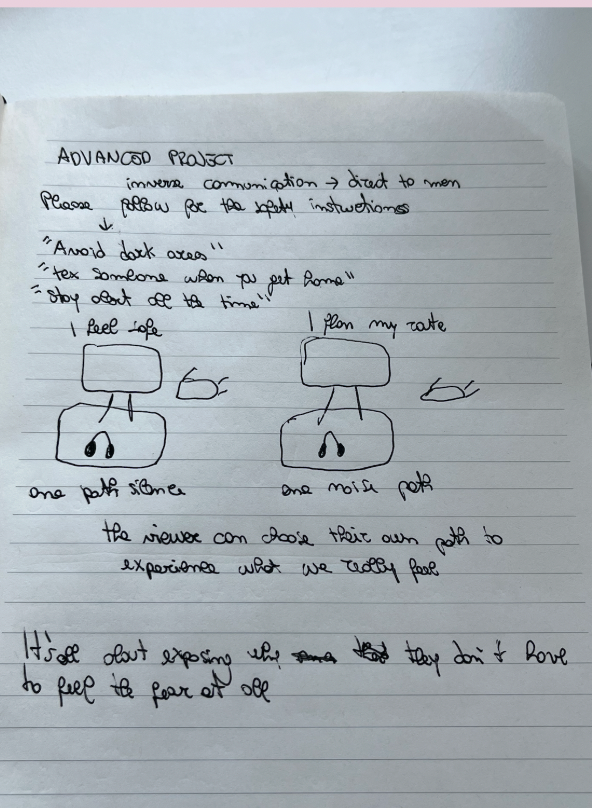
Over the winter break, I completely reframed the project in response to the feedback received in week 11. The research question was refined to focus specifically on how institutional language reinforces the individualisation of responsibility for safety, removing the solution-oriented element entirely. Instead of designing a product, I began using language, form, and visual systems as tools to test and expose how responsibility is constructed and normalised. For the January Crits I presented a early visual experiments of an inverse awareness campaign and an immersive VR installation experience.


ETHICS FORM
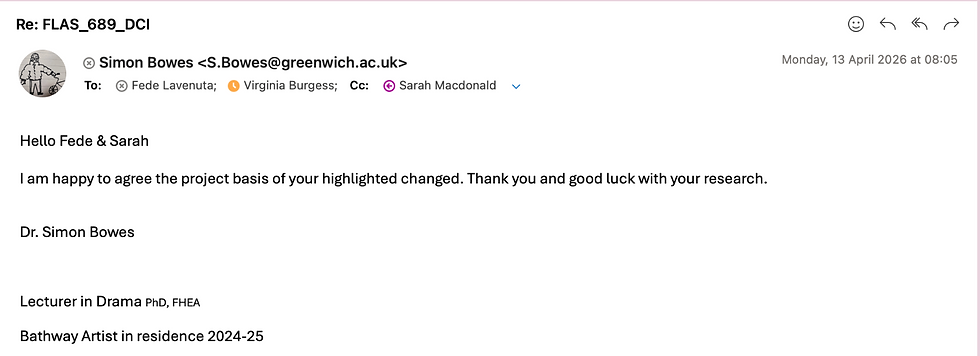
The ethics approval process began in February, when I submitted my first ethics form. Following the initial review, I received feedback requesting a number of improvements before the form could be approved. I addressed all the points raised and resubmitted accordingly. The form was finally approved on 13th April 2026, allowing me to proceed formally with the qualitative research component of the project.
REPORT WRITING
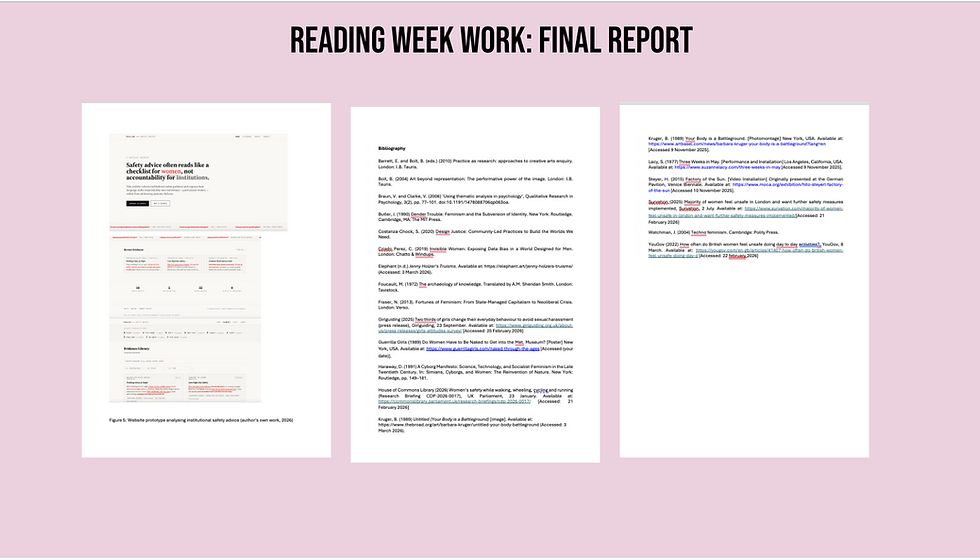
Alongside the practical development of the project, I worked on writing the interim report, focusing on theoretical framework, literature review, methodology, and practice review into a single coherent document. Writing the report pushed me to slow down and think more carefully about the connections between my research, the artists that had influenced me, and the creative decisions I was making.




FEBRUARY CRITS
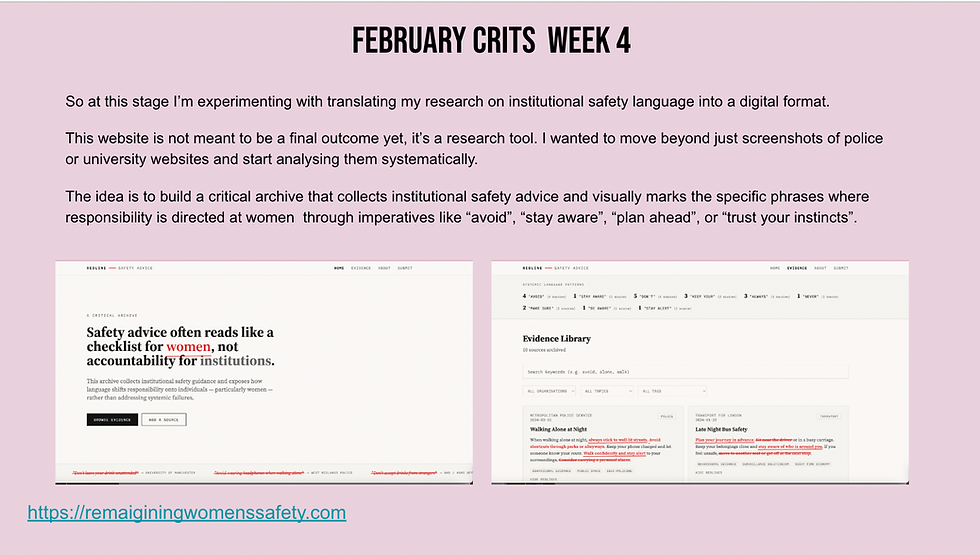
For the February Crits, alongside the posters and the VR experience, I introduced the critical website, an archive collecting and documenting public institutional safety language for critical analysis. At this stage I saw the website primarily as a research tool, a way of gathering and making visible the linguistic patterns I had been analysing. The feedback from the crit encouraged me to push the website further and develop it beyond an archive into something more central to the project. I was also advised to keep experimenting with the campaign, while beginning to step back from making the VR experience the primary focus of the work.
SELF VISITING EXHIBITION
In week 9 of the second term I visited two exhibitions that were relevant to the direction my project was taking. The first was a photographic exhibition in Soho featuring the work of Rene Matić, an installation combining photography, text, and a large suspended banner reading "no place for violence." What inspired me was how language and image worked together spatially to communicate something political as the text wasn't just a caption, it was part of the experience. This connected directly to my own interest in how public language shapes the way we understand violence and responsibility. The second was Chiharu Shiota's exhibition at the Hayward Gallery. Shiota's large-scale immersive installations transform the gallery into an environment you physically move through rather than simply observe. Seeing how space, atmosphere, and movement could generate an emotional and embodied response in viewers was particularly useful at a stage when I was still developing the experiential dimension of my own project.



TUTORIAL WEEK 10 TERM 2
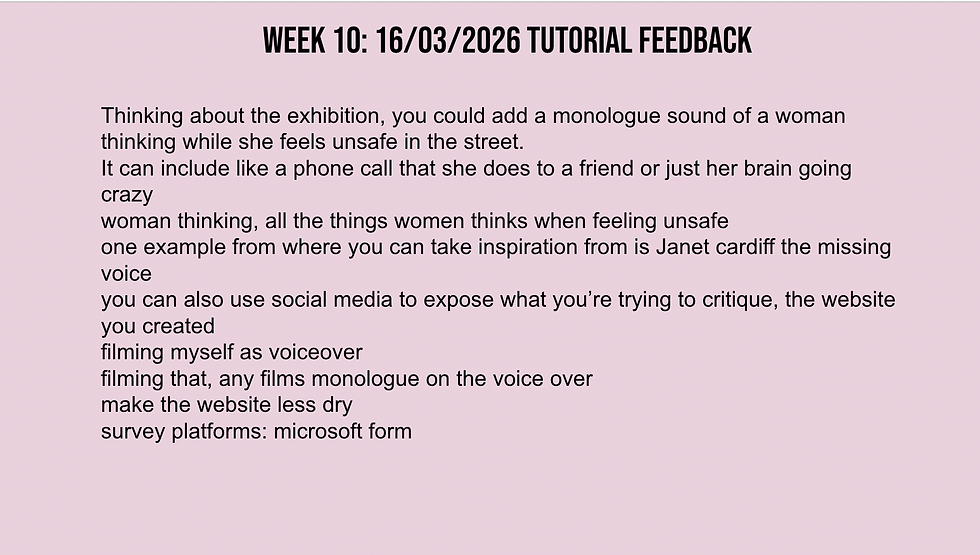
The tutorial on 16th March was a turning point for the project. My supervisor Sarah suggested introducing a monologue representing thoughts of women while feeling unsafe in the street, to make the exhibition more immersive and emotionally immediate. She pointed me toward Janet Cardiff's The Missing Voice as a reference. This feedback shifted my attention toward how the exhibition could work on a sensory and emotional level, not just a visual one, and directly informed the development of the monologue as a key component of the final installation.
PRIMARY RESEARCH
After receiving the ethics approval, I was able to formally begin the primary research. I distributed an anonymous online survey via Microsoft Forms through social media, university networks, and email, open to women aged 18 and over. The questions were structured across three areas: everyday safety behaviours and perceptions, institutional responsibility and public messaging, and the internal emotional and psychological experience of feeling unsafe. This last section was very important, asking participants to describe their thoughts, sensations, and internal monologue in moments of fear; these responses would directly inform the development of the audio monologue for the exhibition. All data was fully anonymised and used to identify recurring patterns, building a picture of how safety is internalised and felt by women on a daily basis.


MARCH CRITS
During the March crit I presented a first draft of the monologue, which I had recorded myself, along with a selection of images I was considering printing and displaying in the exhibition space, and an updated version of the website. The feedback was clear and useful. The monologue was felt to be too fast and not realistic enough, it needed to slow down and feel more natural, more like an actual internal voice. The images were considered unnecessary, adding a visual element that didn't strengthen the work. The website, on the other hand, was what everyone really appreciated, confirming that it was the most compelling output of the project and should be pushed further. This feedback helped me prioritise where to focus the final stages of development.
TUTORIAL 22/02/2026
During the tutorial on April, I presented a new draft of the monologue. The pacing had improved and the overall tone felt more grounded and believable. However, Sarah pushed it further, suggesting working on making the sound quality more realistic and introducing other women's voices alongside my own to create a sense of multiple perspectives. Following this, during the final supervision session, I was able to show the last stages of my work and receive my supervisor's approval before finalising everything. We discussed and agreed on the layout of the exhibition and how the space would be organised. Sarah also gave me practical advice on printing. As the deadline approached, this session was important in confirming the final direction and giving me the confidence to move into the last stage of production.


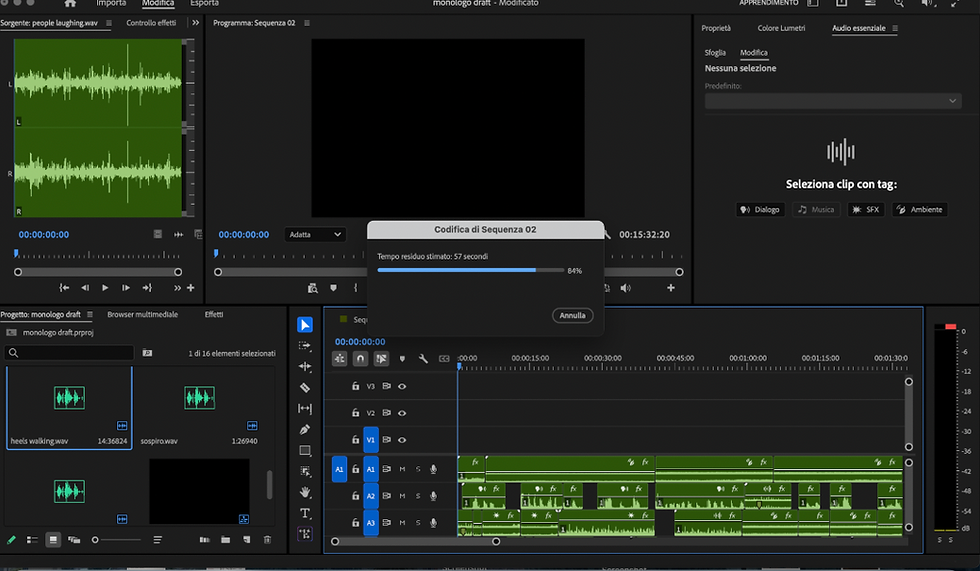

WRITING, RECORDING AND EDITING MONOLOGUES
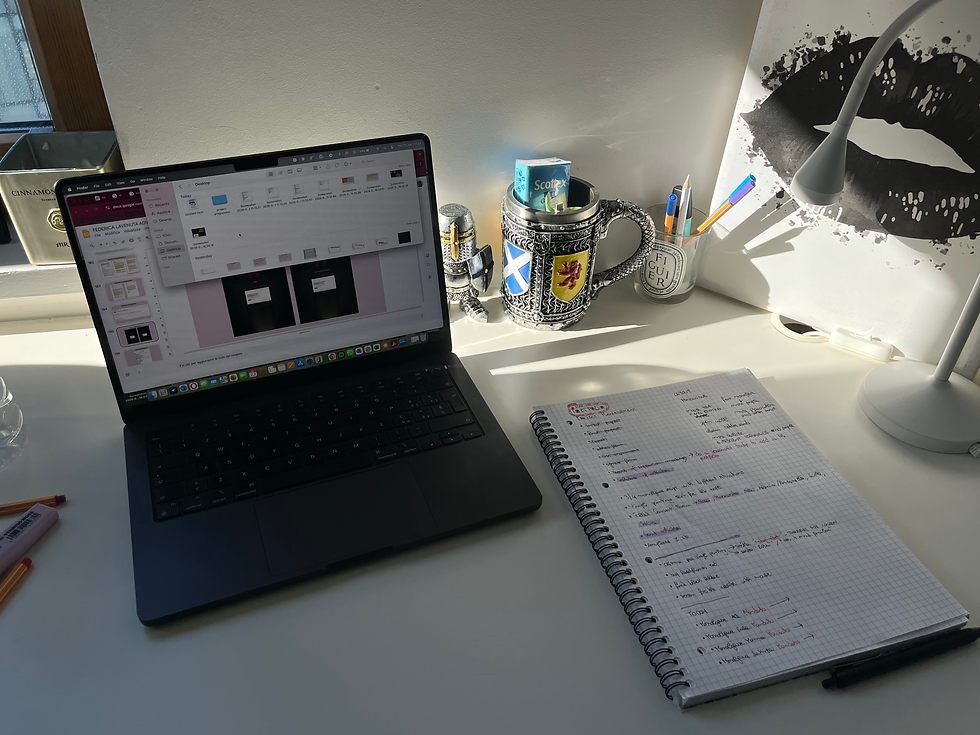
Following the tutorial, I began working on two things in parallel. I started writing scripts for new scenarios of different women's internal voices and the thoughts that run through their heads in moments of feeling unsafe. Alongside this, I continued editing and refining my own recorded monologue, focusing on making it sound more natural and realistic. The goal was to bring these voices together into something that felt collective rather than individual.

Throughout the year I documented the full progression of the project in Google Slides, from September 2025 to the final stages of production. This includes weekly updates, research notes, crit presentations, visual experiments, supervision feedback, notes from workshops and lectures, and my research into the theorists and artists that informed the work, offering a comprehensive record of how the project developed and evolved over the course of the year.